The bond that held
I know that some things aren't chosen. I've heard that before. They find you, slowly, over the years. In this case, through broken lens threads and blurry photographs I was once convinced were memories.
My story with photography starts long before I knew it was a story at all. There was always a camera in the family, or a few of them, I think. Sometimes they worked, sometimes they didn't, but they were always there, within reach, like a quiet witness to everything that happened. I carried them through school, photographed everything and anything, with no knowledge of photography whatsoever, no idea about light, composition, exposure. I waited for the film to be developed with the patience of a child who doesn't know how to wait, or what he's even waiting for. I'd look at those photos, often blurry, poorly taken, and yet I'd see success in every one of them. Especially if the picture had someone I cared about in it. Or someone who was beautiful to me.
Over time, that uncertain, accidental relationship with photography turned into something a little more serious. An ordinary point-and-shoot camera that no longer had any life left in, retired. Out of nowhere, one day, a handful of photos taken by a friend from the neighborhood (a shoutout to Miroslav Jovović) was enough to stop me in my tracks and make me think this was something I should actually try. Although there's some debate about the exact year, in 2008 I found, through an ad, a camera that was, for me at the time, an absolutely professional machine, even though, in all honesty, it was nothing special. A Nikon D60, with the 18-55 kit lens. The same day I bought it, I broke the plastic thread on the lens mount. I remember the agony, the thought that I'd spent so much money on something that, before I'd even had the chance to really get to know it, was already showing signs it might not be meant for me. Even the guy who sold it to me was devastated. I later realized it wasn't about him. Photographers just fanatically love that gear. I brought it to my friend, who at the time worked at a computer repair company, to try to bring it back to life. We glued it together, more out of desperation than any real belief it would work, and to my great surprise, it still holds together to this day. And it still works. I didn't know it then, but that clumsy repair would end up describing far more than a lens mount.
That's really where it begins. I came to understand depth of field, got to know light, not as something that simply exists, but as something that shapes, that decides what a photograph will say and what it will leave unsaid. Over time I changed gear, searched, experimented, trying to figure out what it was I truly wanted, and eventually, what I wanted to photograph. Maybe it's not a coincidence that the technical side of photography drew me in so much. I started out in life as an engineer, and later, finally, chose law as my profession. But IT stayed a significant part of me, somewhere beneath the surface, in the way I think and approach things. Maybe that's why the camera, with all its numbers, settings, and mechanics, felt like a natural place where that engineering curiosity and need for order could meet something completely different. Beauty that can't be measured, no matter how precisely you set the aperture and exposure.
What I've recently admitted to myself is that the irritating number, over all these years, of how many times I broke away from photography only to glue myself back to it, doesn't have to exist anymore. As if something in me kept insisting it clashed with what was supposed to be my primary calling, my focus. That it was secondary, a hobby that shouldn't coexist alongside the seriousness of law. I kept breaking and gluing, breaking and gluing, until I finally accepted that the bond, weak as it looked, was never going to fail. That it was, in fact, part of me. That I didn't have to choose. Practicing law carries its own weight and almost always, alongside all its beauty, sad stories and hard moments in people's lives. Things that stay with you even after you leave the office. As Vlado Perović once jokingly told me, doctor first, then you. And that's where photography became what I actually needed. A way to make the world, which through my work often shows me its hardest side, more beautiful. At least for a moment, at least through one frame or one encounter.
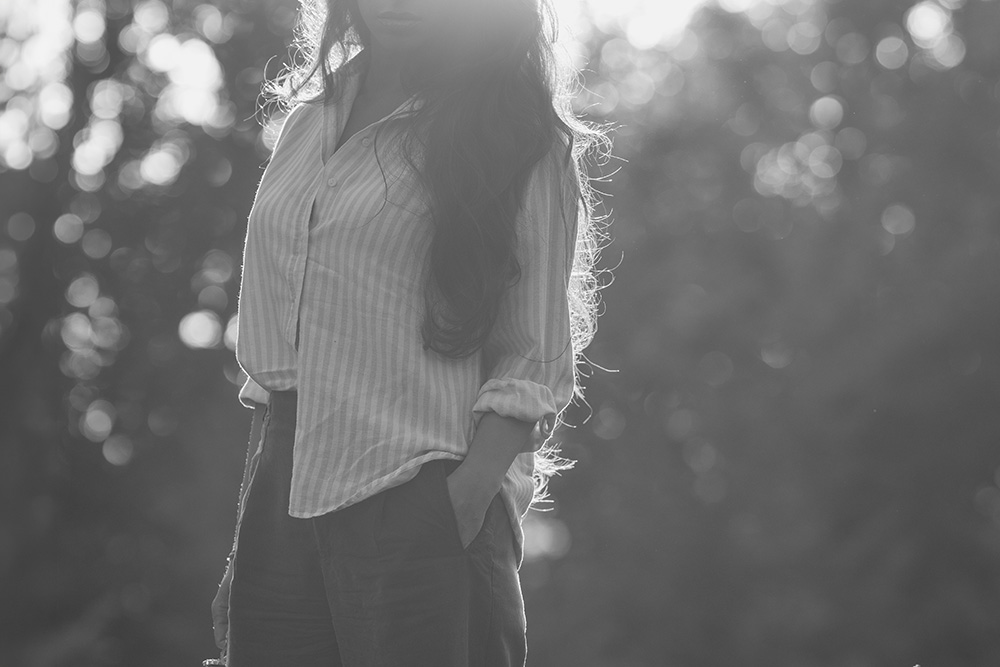
And in that search, over time, something set itself apart quite naturally. There are other things worth attention and time, things I'd love to photograph, and occasionally do, subjects that interest me, but nothing is quite like female beauty. Without any need to explain it, words are often not enough, and the feeling is, of course, personal. I always come back to the same thought. People who simply are, who never ask permission to be what they are, not for a single moment. That kind of freedom can't really be explained, no matter how hard you try. Like a good song you hear for the first time. You feel it, but you can't catch it in words. And it seems to me that it's exactly that elusiveness, that kind of freedom they carry with them, that I'm looking for when I raise the camera. I've thought about why, beyond the obvious, that light in the hair drew me in so much as a subject. The answer is probably somewhere in that almost unfair ease with which, in a way, she steals the light, only to return it to the world more beautiful. Then again, the engineer in me is sure certain laws of physics are involved, but it's not entirely clear to me whether that's really it, or whether it's just an attempt to explain something that resists explanation. Poets, too, have spent centuries trying to describe the same thing, and always ended up falling short. Not because they couldn't write, but simply because there aren't words precise enough for it. Maybe that's an additional reason I turned to the lens instead of words. When you can't describe something, you can at least try to preserve it. To capture that quiet provocation of form.
And maybe that's the final answer to how I ended up here. I started with a broken thread and a camera glued together out of desperation. But somewhere between that child who waited for the film to be developed and the man who today thinks he knows what light means, I discovered that photography, at its core, isn't about the machine, isn't about techniqu. It's a search for what can't be explained. The lens was just the first thing I learned how to glue back together. It turns out I've been doing the same to myself ever since.